



Introduction: Why Sexing a Tarantula Matters
At some point in your tarantula-keeping journey, you’ll ask the question: is it a boy or a girl? Unlike puppies or parrots, you can’t just take a quick glance and know. Tarantulas make things a little trickier, but sexing them is absolutely worth the effort.
Why? Because male and female tarantulas have very different life trajectories. Females live significantly longer, often decades, while most males are lucky if they make it a few years after maturity. If you’re planning on breeding, knowing your spider’s sex is the only way to prepare properly. And even if you’re not, being able to predict lifespan and behavior helps you understand and care for your animal better.
In this article, we’ll go through the main methods of tarantula sexing, explain how to read a molt like a pro, share practical tips, and highlight the most common mistakes keepers make. By the end, you’ll have the confidence to look at your spider,or better yet, its shed skin,and know whether you’re dealing with a gentleman or a lady.
The Obvious Case (Mature Male)
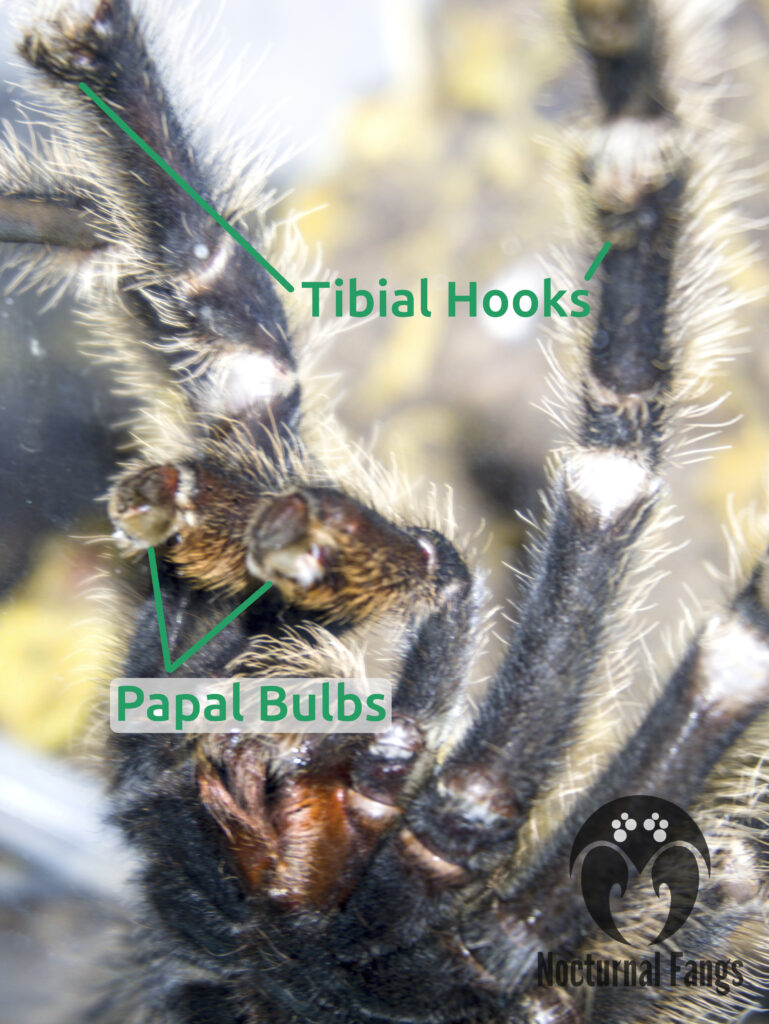
Once a male tarantula has it’s final molt into sexual maturity, the signs become obvious. They will form a set of bulbous instruments at the end of their pedipalps that are used to transfer sperm from the male to the female tarantula. Furthermore, some species also develop so-called tibial hooks, that are used as a support for the mating process, so that both tarantulas can get into the correct position for mating.
Check out Tarantula Anatomy 101: A Complete Beginner’s Guide for more info on tarantula anatomy.

The Two Main Sexing Methods
There are two primary ways hobbyists determine tarantula sex: ventral sexing (looking directly at the underside of the tarantula) and molt sexing (examining a shed exoskeleton). Each comes with its strengths and drawbacks.
Ventral Sexing (The “Look From Below” Method)
This is the method most new keepers try first, usually after seeing pictures online of male and female tarantula undersides. It involves gently observing the spider’s underside, focusing on the area between the first set of book lungs (the oval-shaped openings on the abdomen).
When ventral sexing, some keepers look at the patch just above the epigastric furrow between the first pair of book lungs. In females, it may appear slightly darker or raised due to the developing spermathecae underneath, while in males it remains flat and uniform, but this difference is subtle and unreliable for many species, especially for non-experts.
What you’re looking for:
- In females, there will eventually be a structure called the spermathecae inside, but externally you may notice a small flap or “fold” called the epigastric furrow. Male also have this epigastric furrow, however in female tarantulas this structure tends to be more pronounced.
- In males, this area tends to be flat.
Limitations:
- This method is unreliable in very young spiders, since their sexual features are underdeveloped.
- Lighting, angle, and even the spider’s willingness to show its belly can make it difficult.
- Misidentification is extremely common for beginners.
My advice: ventral sexing is nice for a rough guess, but don’t stake your confidence on it. For accuracy, molt sexing is the real deal. As I am personally not an expert in ventral sexing, I will leave you with this general description and encourage you to look up alternative resources.
Molt Sexing (The Gold Standard)
If you’ve been in the hobby for more than a few months, you have probably noticed that tarantulas shed their exoskeletons regularly, a process we call molting (ecdysis) . This is the perfect opportunity to determine sex, because the shed skin includes key reproductive structures.
Molt sexing is hands down the most accurate method. Once you know what to look for, it becomes a reliable way of separating males from females.
Step-by-Step Guide: How to Sex Your Tarantula Using a Molt
Here’s the process I follow, which works reliably as long as the molt is large enough to handle.
Tools You’ll Need
- Good lighting (a bright desk lamp works well enough).
- Magnification (a magnifying glass, magnifying lamp, or even better: a stereo microscope with 10x to 25x magnification).
- Fine forceps for careful manipulation.
- Pin needles to secure and unfold the molt.
- Small dish of soapy water (for rehydrating the dried molt).
(This sounds like science class all over again. But trust me, it’s far less intimidating once you’ve done it once or twice.)
Step 1: Collect the Molt
When your tarantula molts, resist the temptation to toss the exoskeleton aside or to put it into your neighbors letter box. Gently retrieve it once the spider has moved away and the molt is dry enough to handle. Don’t panic if it looks crumpled, this is normal.
Step 2: Soak the Abdomen
Dried molts are fragile and usually shriveled. Place the abdomen section (not the whole spider shell, just the abdomen piece) into a small dish of lukewarm soapy water. This softens and relaxes the skin so you can work with it without tearing. No nonsense: you will probably tear the fine abdomen skin the first time you try to unfold it. If you keep a skin bin, where you throw away your old molts, use the old molts for practice first.
Step 3: Unfold the Abdomen
Using fine forceps and pins, carefully open the abdomen and spread it flat. The goal is to expose the area between the first set of book lungs. Patience is key here. Rushing will only result in a torn molt and frustration.
Step 4: Locate the Epigastric Furrow
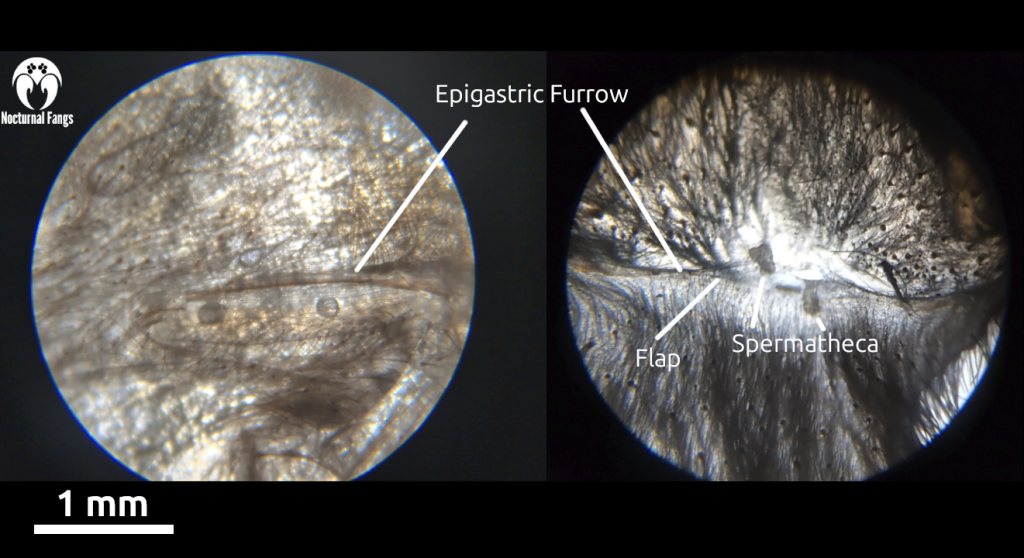
This is the critical area. Look between the first pair of book lungs (towards the carapace), as shown in the figure below. Check out this article (section External Anatomy) to get a better understanding where to find the epigastric furrow.
- In females, you will see a pair of spermathecae (sperm storage organs). They look like small, darkened flaps or lobes. With practice, they become easy to spot. In addition to that, females have a larger flap covering the epigastric furrow, that can usually be moved.
- In males, this area will remain flat, with no developed spermathecae.
Step 5: Confirm with Magnification
Even with good lighting, the difference can be subtle. This is where magnification tools shine. A stereo microscope makes things crystal clear. If you’re committed to the hobby, investing in one is money well spent. Check out this link, if you’re interested.

Limitations of Molt Sexing
Molt sexing is accurate, but not always easy.
- Size matters: Tiny molts are extremely difficult to unfold and examine. Personally, I start attempting sexing once the spider has a diagonal leg span of about 5–6 cm (2 to 2.5 inches). Anything smaller becomes guesswork unless you have surgeon-level dexterity.
- Molt damage: Sometimes the critical area tears during molting. If the spermathecae region is destroyed, you won’t be able to tell.
- Patience required: The process takes practice. Don’t get discouraged if your first few attempts end in crumpled molts.
Common Mistakes in Tarantula Sexing
Even experienced keepers slip up sometimes. Here are the most frequent errors:
- Relying solely on ventral sexing.
Good for a guess, but unreliable without molt confirmation. - Confusing other structures with spermathecae.
Beginners often mistake wrinkles or folds in the molt for female organs. A microscope solves this. - Handling the molt too roughly.
Tarantula molts are delicate. Soak, soften, and take your time. - Using unreliable indicators.
- Growth Rate: Some keepers claim you can sex tarantulas by growth rate. While males tend to grow faster on average, there are too many factors influencing growth rate (such as temperature) that this assessment is unreliable.
- Visual Cues: Males tend to look thinner and leggier once mature (in addition to the presence of clearly visible male sexual organs), but as juveniles they are visually indistinguishable to females.
Why It Matters: Beyond Breeding
Sexing isn’t just about breeding projects. It influences almost every aspect of how you care for your tarantula:
- Lifespan expectations: Females of species like Grammostola pulchra or Brachypelma hamorii can live for 20 years or more. Males often live just a few years after reaching maturity.
- Behavioral changes: Mature males wander, refuse food, and show restlessness. Females stay more sedentary and stable in appetite.
- Housing and care: Knowing when a male has matured helps prevent confusion when he suddenly stops eating or starts climbing the walls of his enclosure like he’s searching for Wi-Fi.
Affiliate Note: Helpful Tools
Since many keepers will be tempted to improve their setup, here are tools worth considering:
- Magnifying lamps or macro lenses (great if you’re working without a microscope).
- Stereo microscopes (best investment if you plan to breed or keep many tarantulas).
- Quality forceps and pins (they make manipulation much easier).
These aren’t luxuries, they make the difference between guessing and knowing.
Conclusion: Practice Makes Perfect
Learning how to sex a tarantula is one of those keeper skills that feels intimidating at first but quickly becomes second nature. Start with molt sexing once your spider is big enough, invest in some basic tools, and don’t be afraid of making mistakes. Every molt is another opportunity to practice.
So next time your tarantula sheds, grab those forceps, set up your lamp, and take a close look. With patience and persistence, you’ll soon be able to say with confidence: “Yep, she’s a lady” or to put on your best Austin Powers impression and say: “It’s a man, baby!”
And who knows, buddy, maybe one day you’ll even find yourself with a mature male drumming at the front of his enclosure, desperately serenading your female. Just don’t play Beethoven for him. He’s not that cultured.
Share this page

Enjoyed this page?
Feeding Tarantulas: Feeder Insects, Storage, and Breeding in DetailFeeding tarantulas looks simple on the surface. Drop in a bug, spider eats it, end of story. In practice, feeder choice influences safety, nutrition, stress levels, enclosure hygiene, and long-term success. This article goes deep into the most commonly used feeders in the tarantula hobby, how big they are at different life stages, what makes them useful or problematic, and how to handle those problems intelligently. The Two Golden Rules Before diving into individual feeders, one guideline applies almost universally: A feeder should not be larger than the tarantula’s body length. The second, and arguably most important guideline is: NEVER feed wild caught animals! Wild caught animals can be contaminated with pesticides or be infected with parasites. If you do not follow this guideline, you are risking your tarantulas health. Crickets (Acheta and Gryllus species) Size and Development Crickets grow through multiple instars, molting frequently until adulthood. Advantages Crickets are …