



The Enclosure as Its Own Small-Scale Ecosystem
The distribution, habitats and ecosystems of tarantulas is just as diverse as our eight-legged friends themselves. You can find them in the Americas (NW), Asia (OW), Africa (OW) and Australia (OW) living in holes in the ground (although not so much Hobbit-like), roaming the earth overground, living on trees and between bark folds and making themselves their home within brambles in the brushland.
Each of those ecosystems comes with it’s own climate and microclimate, and the better we are able to recreate their natural environment, the higher the chances that our spider will thrive.
Enclosure Setup Type
The Terrestrial Enclosure
Ground-dwelling species like the Brachypelma hamorii or the Acanthoscuria geniculata, just to name a few, will mostly enjoy an enclosure with a moderate amount of soil. Just enough that they have the opportunity to burrow their own hide and just enough that there isn’t too much empty head room to avoid potentially hurtful falls from height.
Give them some decor (e.g. cork bark, fake or real plants, figurines and other enrichment) and a water dish, and they will have all they need most of the time. As far as enclosure format goes, a cubic enclosure e.g. 30x30x30 cm (12x12x12″) is usually a good choice, but generally floor space is preferred over height.

The Arboreal Enclosure
For those tarantulas that prefer to stay off the ground, an arboreal type setup is the way to go. Species like the Poecilotheria metallica, the Psalmopeus pulcher or the Avicularia avicularia are among those that thrive in a setup like that.
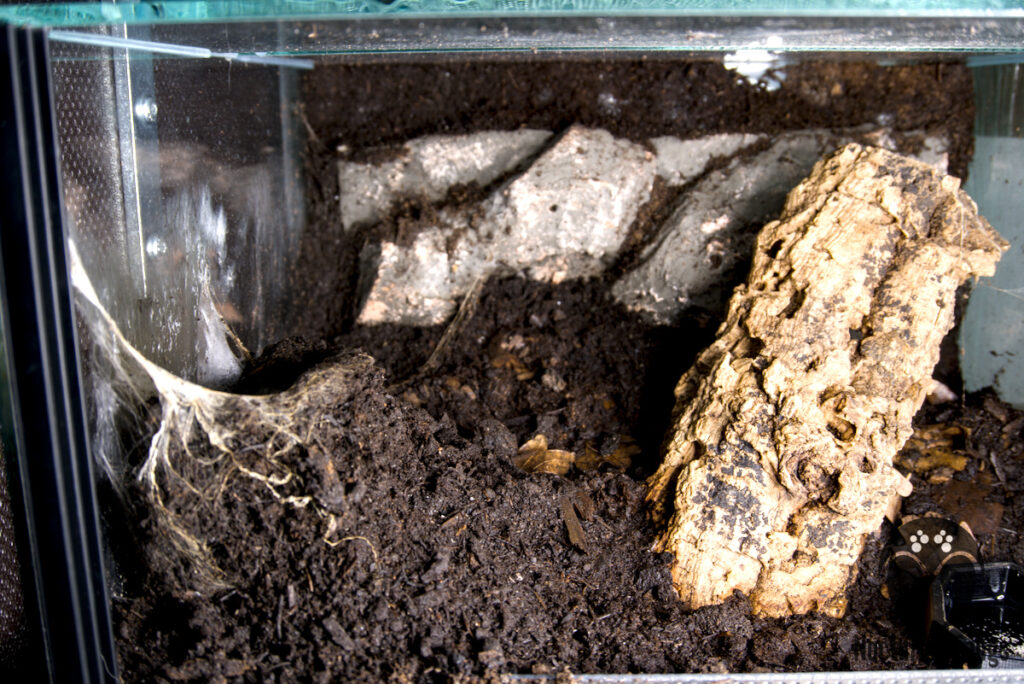
Especially with those tarantulas, custom rock backgrounds, tall cork barks and decor like spider wood are a good addition to the enclosures, as it gives them different opportunities to climb. I see my arboreal tarantulas especially often hanging out on the rock background behind their cork bark, more than on the inside or the outside of the cork bark itself. The soil level can be kept low, just enough that the humidity can be maintained. Alternatively, a drainage layer is also a reasonable option to maintain humidity, especially if the enclosure is planted.
The water dish can be put on the bottom (no worries, the tarantula will find the water dish). Fixing it at height is also an option.
The format of the enclosure will favor height over floor space, and typical dimensions for an adult-sized enclosure are 30x30x45 cm (WxBxH), which is 12x12x18″.
The Fossorial Enclosure
Fossorial tarantula species are mainly found in the Old World, and some of them like to dig, really dig. Beautiful but notorious representatives of this group include the Cobalt Blue tarantula (Cyriopagopus lividus, Thailand) and the King Baboon (Pelinobius muticus, Eastern Africa).
A fossorial enclosure should be set up with one main priority in mind: digging space. A cubic enclosure around 30x30x30 cm (12x12x12″) works well in most cases. For fossorial setups, a top opening enclosure is preferable to a front opening one, since it allows you to fill roughly two thirds of the total enclosure volume with substrate.
If you cannot get hold of a top opening enclosure, a front opening enclosure can still be used. In that case, make sure to slope the substrate upwards toward the back of the enclosure so there is still enough depth for proper burrowing. Substrate volume is king for fossorial tarantulas, but do not overdo it. The spiders still need some free space to manage their excavated soil. Also, do not be surprised if they completely bury decorations and even their water dish. Always check regularly and make sure a clean water dish remains accessible.
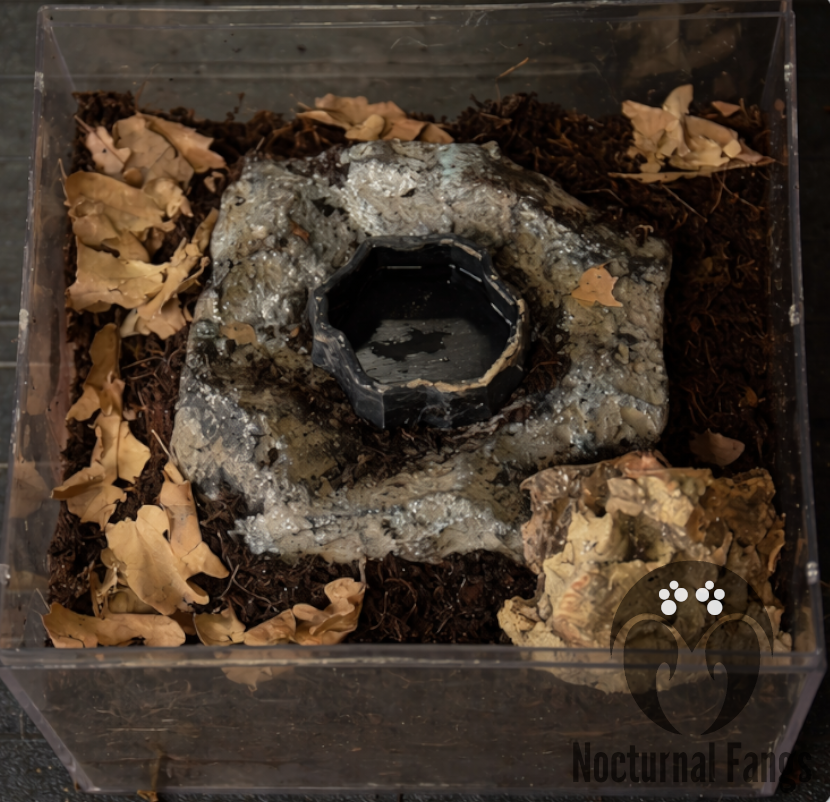
With fossorial setups, luck plays a role. Sometimes the tarantula will burrow exactly where you hoped, usually along the glass pane, allowing you to observe its tunnel system. Other times, it will dig straight toward the center of the enclosure, where it becomes almost invisible. One way to increase your chances is to provide a starter burrow, essentially a pre made, tarantula sized hole. This can encourage the animal to begin digging in the desired location, but it does not guarantee success.
There is, however, a method that reliably ensures you will be able to observe your tarantula’s tunnels: blocking burrowing toward the center. This can be achieved by placing a solid rock decoration in the middle of the enclosure, as shown in the picture below. By physically limiting the available digging direction, the tarantula is forced to excavate along the glass, making its burrow visible. I documented this process in detail here (external link to YouTube).
Humidity and Ventilation Considerations
When setting up a tarantula enclosure, it is essential to understand the natural environment of the species you are keeping. Tarantulas from tropical rainforests, such as Avicularia species, require higher humidity levels, abundant ventilation, and climbing opportunities to replicate the dense, humid canopy they inhabit. On the other hand, species from scrublands or arid regions, like Brachypelma or Aphonopelma, thrive in drier conditions with lower substrate moisture and stronger emphasis on ventilation to avoid stagnant, mold-prone environments.
By researching your tarantula’s origin, you can tailor the climate inside the enclosure to suit its physiological needs, which directly influences health, feeding response, and longevity.
For moisture control, the substrate plays a key role, but enclosure design (ventilation area and placement) is just as important. A deep substrate that retains some moisture in the lower layers while staying dry on the surface creates a natural humidity gradient without turning the enclosure into a swamp. In larger enclosures, a simple drainage layer (see Ultimate Guide to Tarantula Substrates) beneath the substrate can help prevent waterlogging, especially when live plants are used or occasional misting is required.
At the same time, ventilation design strongly influences how well this moisture balance is maintained. Top ventilation, such as mesh lids, allows moisture to escape very efficiently and often makes stable humidity harder to achieve. Side ventilation, particularly when combined with a controlled amount of top ventilation, promotes proper airflow without excessive drying. Ultimately, it is not just the placement of ventilation that matters, but the total ventilation area as well. A well-balanced enclosure allows fresh air to circulate while retaining enough moisture, reducing the need for frequent misting and supporting a stable microclimate.


Decor and Layout
Decoration in a tarantula enclosure goes beyond aesthetics. A properly structured layout provides essential hiding spots, climbing options, and environmental enrichment that reduces stress. Hides such as cork bark tubes, half logs, or clay pots give your tarantula a secure place to retreat, which is vital for molting and general well-being. Branches and vertical cork pieces are particularly beneficial for arboreal species, while fossorial tarantulas need deep substrate and minimal clutter to maximize their burrowing activity. Live plants can add both humidity regulation and a naturalistic appearance, though artificial plants are often easier to maintain.
I personally am an advocate for using 3D-printing tarantula enclosure decoration. See this previous blog post for reference. You don’t even need to be creative yourself. Thingiverse offers a vast range of free 3D-files.
Avoid unsafe decor items such as sharp rocks, resin ornaments with narrow openings that can trap a spider, or unstable objects that may collapse during burrowing. A stable, thoughtfully arranged enclosure helps your tarantula exhibit natural behaviors safely.
One Mistake to Avoid an Final Words
I want to end this article by pointing out a mistake that even experienced keepers sometimes make: designing an enclosure solely around the tarantula’s needs, while completely overlooking the needs of the keeper. Good husbandry does not stop at what is ideal for the animal, it also includes practicality and safety for the person maintaining the enclosure. So when you set up your next enclosure, take a moment to consider the following points:
- Is the water dish placed in a spot where it is easy to access and refill without disturbing the tarantula?
- If you added a hide, is it positioned far enough away from the opening to minimize the risk of the tarantula bolting out during maintenance?
- Did you include decorations or features that may be perfect for the tarantula, but effectively guarantee that you will never see it again (what I like to call super amazing hides)?
A well designed enclosure balances the needs of the animal with the realities of day to day care, because an enclosure that is frustrating to maintain will never be maintained as well as it should be.
Share this page

Enjoyed this page?
Is My Tarantula Dying? Common Behavior and Emergencies ExplainedForeword The health and well-being of our eight-legged friends is important to every keeper, which is why accuracy matters in an article about emergencies. If you are an experienced keeper or have a background in invertebrate medicine and notice anything that could improve the information in this guide, I welcome your suggestions. You can reach me at contact@nocturnalfangs.com. Disclaimer: This guide is based on current knowledge and practical experience, but it is not a substitute for professional veterinary advice. What Counts as an Emergency? Not every behavior is dangerous, but knowing how to react to tarantula emergencies is part of good husbandry. Many new keepers panic the first time their spider stops eating, hides for weeks, or flips onto its back. The truth is that most of these situations are normal parts of tarantula behavior. However, there are a few circumstances where quick action can make the difference between life …